Managed MCP for AWS: Standardizing Agent Access with Least Privilege, Auditing, and Fewer Bespoke Integrations
As AI coding agents move from side projects into real operational workflows, the biggest risk isn’t capability—it’s uncontrolled cloud access. AWS’s newly GA AWS MCP Server offers a managed, authenticated path for agents to interact with AWS services, helping modernization teams reduce integration sprawl and bring “shadow agents” back under governance.
Modern engineering teams are increasingly letting AI agents do more than write code: they propose infrastructure changes, pull logs during incidents, and help automate migration tasks. That’s great—until every agent has its own one-off credentialing scheme, custom glue code, and unclear audit trail.
When cloud access becomes “whatever the agent needs,” security and governance start to erode. And when governance blocks progress, teams often route around it—creating shadow agents that operate outside approved controls.
AWS’s newly generally available AWS MCP Server is a timely step toward standardizing how coding assistants and AI agents access AWS—securely, auditable by design, and aligned with least-privilege governance.
Context: Why agent-to-cloud access is becoming a governance problem
Modernization programs (re-platforming, refactoring, strangler patterns, database upgrades, Kubernetes migrations) rarely fail because of missing tools. They fail because workflows become unmanageable as complexity grows: more services, more environments, more runbooks, more permissions models.
Add AI agents and you introduce a new kind of integration sprawl:
- Every team wires their agent into AWS differently (CLI wrappers, custom Lambdas, bespoke token brokers).
- Permissions are often coarse because it’s “hard to scope quickly.”
- Auditing is inconsistent—some actions show up as a human, some as a shared role, some not at all.
- Security reviews slow down delivery, which pushes experimentation into ungoverned corners.
That’s the heart of the problem: agents aren’t just code generators anymore—they’re becoming operators. And operators need identity, authorization boundaries, and traceability.
AWS MCP Server GA: a managed path to secure, authenticated agent access
AWS announced general availability of the AWS MCP Server in the AWS News Blog: “The AWS MCP Server is now generally available.” The post positions it as a managed remote Model Context Protocol (MCP) server designed to give AI agents and coding assistants secure, authenticated access to AWS services—a framing that directly speaks to enterprise governance requirements. (Primary source: https://aws.amazon.com/blogs/aws/the-aws-mcp-server-is-now-generally-available/)
If you’ve been watching the agent ecosystem, the key detail here is managed and remote.
What MCP changes (in plain terms)
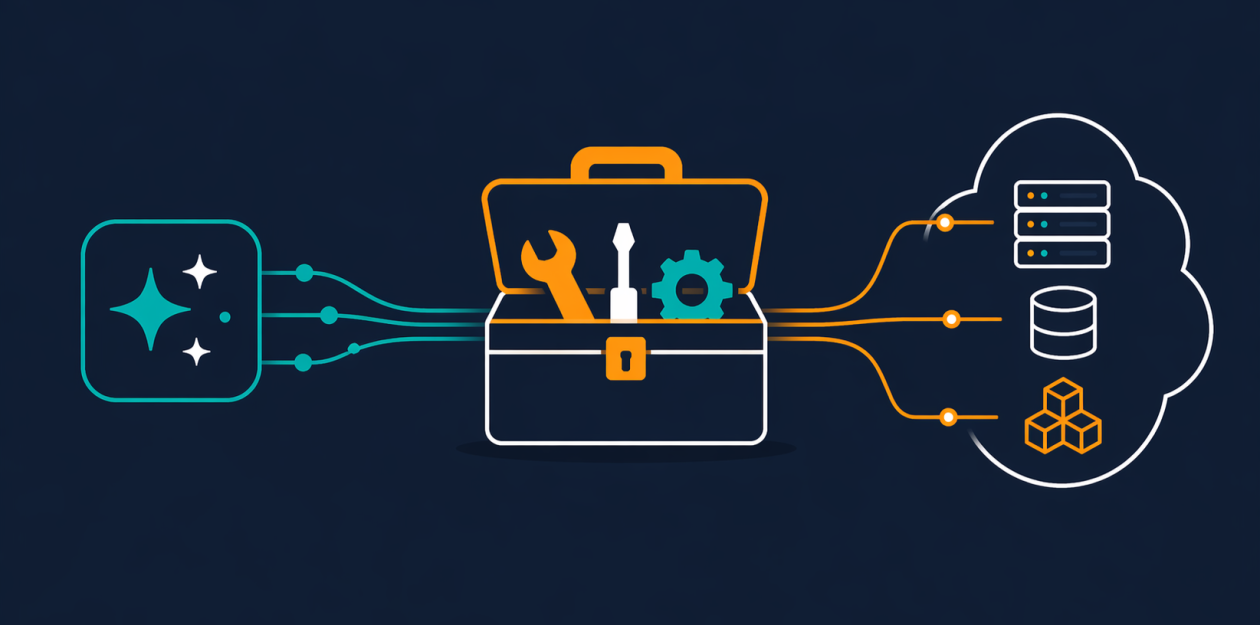
Model Context Protocol (MCP) is a standard way for an agent (client) to request tools and context from a server. Instead of every agent integration being a custom plugin with its own auth and wiring, MCP aims to standardize the interface.
In practice, MCP can help you:
- Define a consistent “tool surface” for cloud actions (list resources, fetch logs, query config, open tickets, etc.).
- Centralize authentication and authorization patterns.
- Reduce duplicated integration code across agents and teams.
Why “managed remote server” matters
A self-hosted MCP server still leaves you solving the hard parts: identity, policy, audit, patching, and operational overhead.
A managed MCP server shifts that burden. AWS’s positioning emphasizes secure and authenticated access, which is exactly the conversation enterprises need to have before agents can touch production environments.
The real win: fewer bespoke integrations and a smaller “shadow agent” surface area
Most organizations don’t intend to create shadow automation. It happens because the paved road is too slow.
Integration sprawl looks harmless—until it isn’t
A typical pattern today:
- A developer tries a coding assistant.
- They add “just enough” AWS access (often broad) to make it useful.
- They create a small internal wrapper to run actions.
- Another team repeats it with a slightly different setup.
Soon you have:
- Multiple credential brokers
- Multiple patterns for assuming roles
- Inconsistent naming and tagging
- Hard-to-reconstruct agent actions during incidents
Standardizing on a managed MCP approach helps create a single, reviewable access path—especially valuable in modernization programs, where the number of operational changes is high and mistakes are costly.
Shadow agents are a governance failure mode
When developers can’t get sanctioned access patterns quickly, they’ll:
- Use personal credentials
- Reuse shared roles
- Embed keys in local tooling
- Run “temporary” scripts that become permanent
A managed MCP server can help you keep experimentation inside guardrails: give agents capabilities, but on your terms—with consistent identity and auditable activity.
Security and governance: authn/authz, auditing, and least privilege—made central
For engineering leaders, the core question isn’t whether agents can do things in AWS. They already can. The question is whether you can adopt them without weakening cloud controls.
Authentication: who is the agent acting as?
If an agent triggers an AWS action, you need a crisp answer to:
- Is it acting as a developer user, a service role, or a dedicated agent identity?
- Is access time-bound?
- Is it tied to an approved workflow or ticket?
AWS’s messaging around the MCP Server emphasizes secure, authenticated access—an essential foundation for answering those questions at scale.
Authorization: can we enforce least privilege per workflow?
Least privilege isn’t just “read-only vs admin.” In modernization and operations, permissions should be scoped by:
- Environment (dev/test/prod)
- Service boundaries (only ECS, only CloudWatch, only S3 buckets with a prefix)
- Action category (diagnose vs mutate)
- Time window (break-glass vs steady-state)
A centralized MCP access layer makes it more realistic to implement workflow-based authorization, because you’re not repeating policy logic in every agent integration.
Auditing: can we prove what happened during an incident or migration?
When agents help with incident response, postmortems become harder if you can’t correlate:
- The agent’s suggestion
- The tool invocation
- The exact AWS API calls
- The identity and policy evaluated
Standardizing access through a managed MCP server can simplify audit trails and reduce the “we think the bot did it” ambiguity.
How this connects to modernization and software maintenance
Vibgrate customers (and modernization teams broadly) deal with two parallel tracks:
- Modernize the platform (services, infrastructure, pipelines)
- Modernize operations (runbooks, incident response, compliance reporting)
Agents are increasingly used in track #2, and the risk is that operations modernization gets ahead of governance modernization.
From legacy runbooks to governed automation
Many organizations still have runbooks as:
- Wiki pages
- Shell scripts on a jump box
- Tribal knowledge in Slack
Agents can help translate those into repeatable workflows—but only if the access layer is safe.
A managed MCP server can become a standard “control plane” for agent execution, enabling you to:
- Keep runbook automation consistent across teams
- Reduce copy/paste operational scripts
- Enforce approvals and role boundaries
- Build toward self-service operations without opening the floodgates
Avoiding toolchain drift during cloud migration
During cloud migration or re-platforming, teams commonly introduce temporary tooling: one-off scripts for discovery, IAM tweaks, inventory exports, and cutover checks.
If agents participate, the temptation is to grant broad access “for the migration.” Months later, those permissions and integrations remain.
Centralizing agent access patterns helps you treat migration tooling like production software:
- versioned
- reviewable
- permissioned
- auditable
Practical implications for engineering teams
Here are concrete ways to use a managed MCP approach to reduce risk and speed delivery.
1) Create an “agent access baseline” alongside your AWS landing zone
Most orgs already define:
- account structure
- SCPs / guardrails
- logging baselines
- network boundaries
Add an agent access baseline:
- approved MCP endpoint(s)
- standard IAM roles for agent workflows
- environment scoping rules
- tagging conventions for agent-initiated actions
Treat this as part of your modernization platform, not an experiment.
2) Start with read-only and diagnostic workflows
The fastest safe wins are:
- querying CloudWatch logs/metrics
- listing infrastructure state
- analyzing IAM policy impact
- summarizing incident timelines
These deliver value without giving agents mutation privileges. As confidence grows, expand to controlled changes (e.g., restarting services, scaling actions) with explicit approvals.
3) Separate “suggest” from “apply”
A strong pattern for governed automation:
- Agent generates a plan (diff, change set, runbook steps)
- Human reviews or automated policy checks validate
- Agent executes through a constrained tool surface
An MCP-based approach makes it easier to standardize this pattern across different agents and IDE assistants.
4) Centralize auditing requirements early
Before you let agents touch production, decide:
- What identifiers must be present in logs (agent name, session, ticket)
- Where audit records live (CloudTrail, SIEM, internal event store)
- How you’ll reconstruct an execution timeline
Then enforce it as part of the access layer—not as a best-effort per team.
5) Reduce “plugin soup” by standardizing tool access
If every assistant requires a custom plugin to reach AWS, you’ll repeat security work and create uneven experiences.
With MCP, you can aim for:
- one standardized way to access AWS tools
- consistent guardrails
- less custom code to maintain
This is pure software maintenance hygiene: fewer bespoke adapters means fewer brittle dependencies to patch during upgrades.
Conclusion: a paved road for agent-driven operations
The AWS MCP Server’s general availability is a signal that agent-to-cloud access is shifting from novelty to infrastructure. AWS is positioning the service around secure, authenticated access—exactly the foundation enterprises need to scale agent-driven automation without losing governance.
For developers, it’s a simpler way to build powerful operational assistants. For CTOs and platform leaders, it’s a chance to reduce integration sprawl, contain shadow agent risk, and modernize legacy runbooks into governed automation.
The forward-looking opportunity is clear: treat agents like any other production actor in your cloud—with standardized identity, least privilege, and auditable execution—so modernization accelerates without punching holes in your controls.