
A user does not have to type a password for an attacker to take over their Microsoft 365 account. In some cases, they only need to approve the wrong OAuth prompt or paste the wrong command into the wrong place.
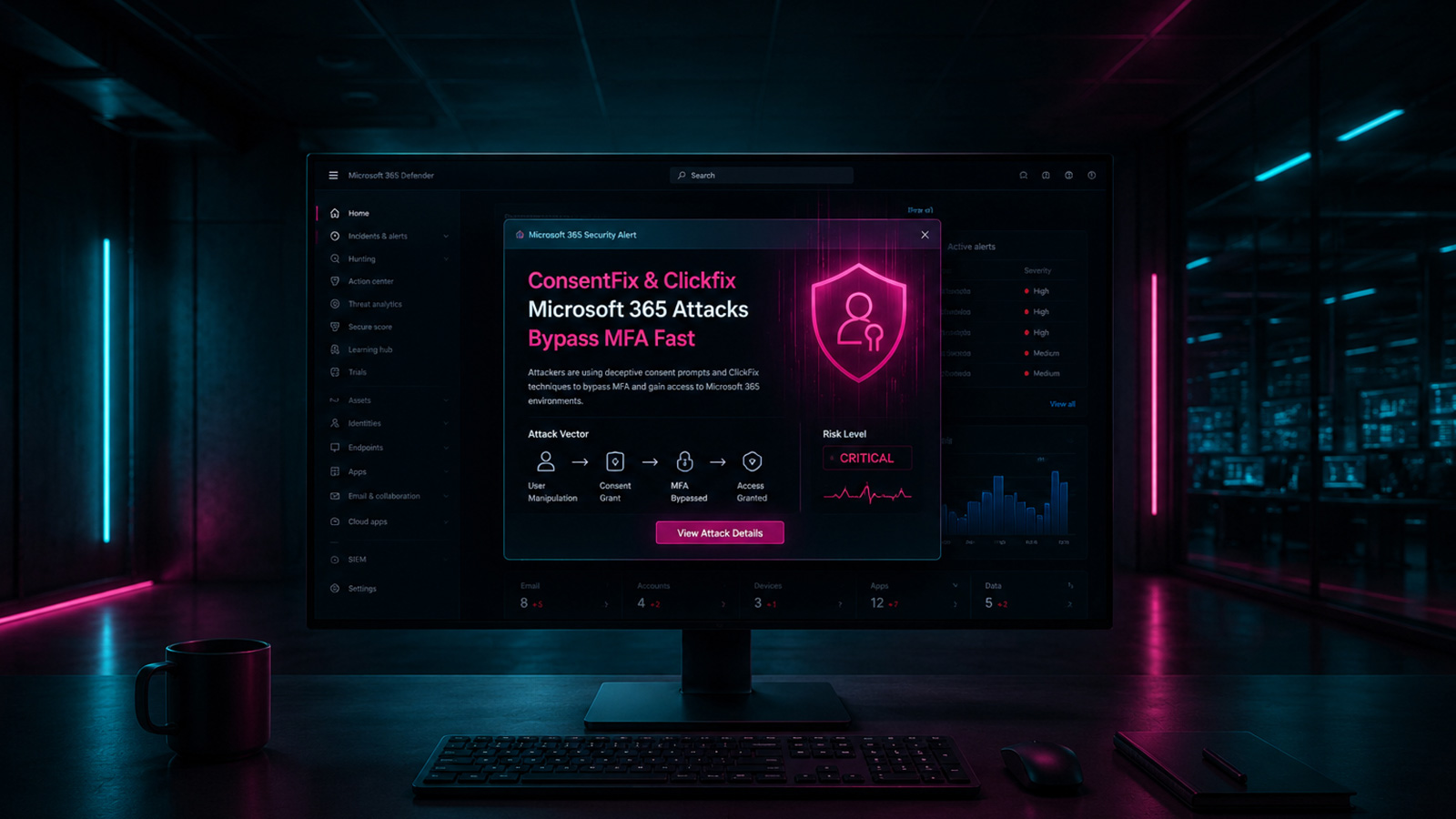
That is the uncomfortable lesson from recent ConsentFix and ClickFix attack research covered by BleepingComputer, which describes how Microsoft 365 tokens can be stolen in seconds using fake prompts and malicious OAuth flows. For teams that have treated multi-factor authentication as the finish line for identity modernization, this is a warning: MFA is necessary, but it is no longer sufficient by itself.
Identity Attacks Have Moved Beyond Password Theft
For years, identity security programs focused on a straightforward progression: eliminate shared accounts, require strong passwords, centralize identity, and roll out MFA. Those steps are still important. But attackers have adapted to environments where passwords are harder to steal and MFA prompts are more common.
Instead of only trying to capture credentials, modern identity attacks increasingly target the systems around authentication:
- OAuth consent screens
- Browser permission prompts
- Clipboard behavior
- Shell and terminal execution paths
- Device authorization workflows
- User trust in familiar-looking UI patterns
This shift matters because many organizations still treat these areas as usability concerns rather than security boundaries. OAuth consent is often seen as an application integration issue. Clipboard behavior is usually considered a browser or endpoint feature. Command prompts are treated as developer or helpdesk tools. But attackers are turning each of these into an identity attack surface.
BleepingComputer’s report on ConsentFix and ClickFix attacks highlights how these techniques can steal Microsoft 365 tokens quickly using fake prompts and OAuth flows. The attacks are described as MFA bypass tactics because they do not always need to defeat the second factor directly. Instead, they trick users into granting access or executing commands that result in token theft.
How ConsentFix and ClickFix Change the MFA Conversation
MFA raises the cost of account takeover, but it does not eliminate the value of tricking a user into completing an action. ConsentFix and ClickFix work because they exploit user expectations, not just technical weaknesses.
ConsentFix: Abusing OAuth Trust
OAuth consent flows are designed to let users authorize applications to access data or services without sharing passwords. In a healthy environment, this is useful and necessary. Developers connect productivity tools, automation platforms, and internal apps to Microsoft 365 and other SaaS systems every day.
The problem is that OAuth consent can also become a delegation mechanism for attackers. If a malicious or impersonated app convinces a user to grant permissions, the attacker may receive tokens that provide access to mail, files, profile data, or other cloud resources. Depending on the granted scopes and tenant configuration, the attacker may be able to maintain access even if the user changes their password.
That is why ConsentFix-style attacks are so dangerous. They do not necessarily ask the victim to hand over a password. They ask the victim to approve something that looks routine. In organizations where users frequently authorize SaaS integrations, that prompt may not feel suspicious.
ClickFix: Turning Troubleshooting Into Execution
ClickFix attacks use a different but related form of social engineering. Instead of relying on an OAuth consent prompt, they trick users into copying and running malicious commands. The lure often looks like a verification step, a browser fix, a CAPTCHA issue, or a helpdesk-style instruction.
The attacker’s goal is to move from browser interaction to local command execution. Once a user pastes a command into a Run dialog, terminal, PowerShell window, or browser console, the attacker may be able to execute malware, steal tokens, or establish persistence.
Opera’s new Paste Protect feature, covered separately by BleepingComputer, is a useful example of browser vendors responding to this trend. Opera introduced Paste Protect to block ClickFix-style attacks that trick users into executing malicious commands through social engineering. That is significant because it recognizes clipboard-to-command execution as a security boundary, not just a user behavior problem.
Why MFA Bypass Does Not Always Mean MFA Failure
When security teams hear MFA bypass, it is tempting to evaluate the issue narrowly: Was the MFA implementation weak? Was push fatigue involved? Was a one-time code intercepted?
ConsentFix and ClickFix show a broader reality. Attackers may bypass MFA by avoiding the primary login sequence altogether. If they can obtain a valid token, abuse a previously authorized app, or cause the user to execute a token-stealing command, they may not need to challenge the MFA mechanism directly.
This distinction is important for CTOs and engineering leaders because it changes the remediation strategy. The answer is not simply more MFA. The answer is identity surface reduction.
That means asking questions such as:
- Who can grant OAuth consent in the tenant?
- Which applications already have delegated permissions?
- Are high-risk OAuth scopes restricted or monitored?
- Can users paste commands from web pages into execution contexts without friction?
- Do browsers and endpoints warn users before dangerous clipboard actions?
- Are tokens protected, scoped, monitored, and revoked when risk is detected?
MFA remains a core control. But it must sit inside a wider identity security architecture that accounts for consent, tokens, browsers, devices, and user workflows.
The Maintenance Angle: Identity Debt Accumulates Quietly
Many maintenance teams inherit identity environments that have grown over years. SaaS integrations are approved during urgent projects. Internal tools are granted broad permissions because least-privilege design would take longer. Legacy authentication exceptions remain in place because one old workflow depends on them. Browser and endpoint standards vary across business units.
This is identity debt.
Like technical debt in application code, identity debt often accumulates through reasonable short-term decisions. But over time, it creates a system where attackers have too many paths around the intended security model.
OAuth consent is a common example. A company may begin with a permissive model because developers and business teams need to move quickly. Years later, dozens or hundreds of apps may have access to Microsoft 365 data, some with permissions no one has reviewed recently. When a ConsentFix-style attack appears, the organization discovers that consent governance was never fully operationalized.
Clipboard and command execution paths are another form of debt. Developer workstations, IT admin devices, and power-user machines often allow flexible scripting and command-line access. That flexibility is valuable, but it also raises the impact of ClickFix-style social engineering. If users are accustomed to pasting commands from documentation, chat, tickets, or web pages, attackers can imitate that workflow.
Security modernization should therefore treat these issues as part of routine platform maintenance, not as one-off incident response tasks.
Practical Implications for Engineering Teams
Engineering and maintenance teams can reduce exposure by focusing on four areas: OAuth governance, browser and endpoint hardening, token visibility, and user workflow design.
1. Review and Restrict OAuth Consent
Start by inventorying OAuth applications and permissions across Microsoft 365 and other identity providers. Look for apps with broad delegated permissions, stale usage, unclear ownership, or publisher risk.
Practical steps include:
- Require admin approval for high-risk OAuth scopes.
- Disable user consent where appropriate, or limit it to verified publishers and low-risk permissions.
- Establish an application review process for new SaaS integrations.
- Remove unused or abandoned enterprise applications.
- Monitor consent events and alert on suspicious grants.
This does not mean blocking all integrations. It means treating OAuth consent like production access: reviewed, owned, logged, and revocable.
2. Harden Browser Behavior and Clipboard Paths
Opera’s Paste Protect feature is notable because it addresses the mechanics of ClickFix attacks. Organizations should evaluate whether their standard browsers, endpoint tools, and security policies provide similar protections or warnings.
Teams should consider:
- Browser policies that restrict risky clipboard interactions.
- Endpoint detection rules for suspicious PowerShell, shell, or Run dialog activity.
- Warnings or blocks when commands are pasted from untrusted web contexts.
- Limiting script execution on non-developer workstations.
- Separating developer flexibility from general workforce defaults.
For developer environments, the goal is not to eliminate command-line usage. The goal is to make dangerous transitions visible: from web page to clipboard, from clipboard to shell, and from shell to network or credential access.
3. Improve Token Monitoring and Revocation
If attackers are stealing tokens, password resets alone may not be enough. Incident playbooks should include token revocation, OAuth grant removal, session invalidation, and review of refresh token activity.
Useful controls include:
- Conditional access policies based on device compliance and risk signals.
- Shorter token lifetimes for sensitive applications where practical.
- Continuous access evaluation where supported.
- Alerts for anomalous token use, impossible travel, or new app consent.
- Automated disablement or quarantine for suspicious OAuth applications.
Modern identity defense is increasingly about session integrity. Teams need to know not only who authenticated, but which tokens exist, what they can access, and whether their behavior has changed.
4. Redesign User-Facing Prompts and Training
Security awareness training often tells users not to click suspicious links. That is too vague for ConsentFix and ClickFix. Users need specific guidance about consent prompts and command execution.
Training should make clear that:
- OAuth consent grants can provide real access to company data.
- Verification pages should never require users to run local commands.
- CAPTCHA or browser fixes that involve PowerShell, Terminal, or Run dialogs are suspicious.
- Users should report unexpected permission prompts, even if they look official.
Product and internal tooling teams can help by making legitimate workflows easier to distinguish. Standardize internal consent approval pages, document approved support procedures, and avoid training users to paste opaque commands unless there is a controlled process.
Where CTOs Should Invest Next
For CTOs, the strategic takeaway is that identity modernization should expand beyond MFA coverage metrics. A dashboard that says 98 percent of users have MFA enabled is useful, but incomplete.
A stronger modernization roadmap should include metrics such as:
- Percentage of OAuth apps with assigned owners
- Number of high-risk delegated permissions granted
- Time since last enterprise app review
- Percentage of endpoints with browser and clipboard protections enabled
- Token revocation time during incidents
- Coverage of conditional access policies for sensitive apps
- Reduction in legacy authentication and unmanaged device access
These are maintenance metrics as much as security metrics. They show whether the identity platform is being actively governed or merely configured once and left to drift.
Conclusion: Treat Consent and Clipboard Actions as Security Boundaries
ConsentFix and ClickFix attacks are a reminder that attackers follow the path users are trained to trust. If users are accustomed to approving OAuth prompts and pasting commands into execution contexts, those workflows become part of the attack surface.
MFA is still essential, but it is not the final state of identity modernization. The next phase is hardening the surrounding surfaces: OAuth consent, browser prompts, clipboard behavior, token management, and command execution paths. For engineering and maintenance teams, reducing this identity debt should be part of ongoing platform modernization, not an emergency project after the next token theft campaign.